Showing posts with label air. Show all posts

Wednesday, September 09, 2009

Bring on High Speed Two, not more runways

rail planRegular readers will know I think high-speed rail is a necessity. Today, on BBC.com there was an interesting statistic in this news article: Cities urge high-speed rail lin

Over 60 years, it is estimated that the line could save 30 million tonnes (29.5m tons) of CO2 worth £3.2bn by diverting passengers from air travel to rail.

Although 60 years can seem a very long time, rail infrastructure is ammortised over long periods. The real saving could be that a proper high-speed rail (HSR) network could avoid building more runways around London. I'm sure BAA thinks differently, but it worked just like that in France where TGV has displaced air travel on routes such as Paris to Nantes, Lyons, and even Marseilles.

Will this happen in the UK? I'm sceptical it will happen quickly, mostly because of the lack of proper planning, decentralised decision making and short-term focus.


, , , , , , , , ,

Monday, August 31, 2009

BAA caught lying... again.

The list of BAA lies is very very long, Terminal 4 was going to be the last one, then it was Terminal 5 to be the last expansion, the planes noise data is based on theoritical levels and future emissions calculations are based on planes that don't exist.

The Advertising Standards Authority has caught them for the last one:
BBC NEWS | England | London | Heathrow noise claim 'misleading'

According to BAA, the Government said that a third runway would "would have to result in a Heathrow noise footprint no larger than with two runways in 2002, and that concentrations of nitrogen dioxide around Heathrow would have to be within the future EU limit."

So BAA would buy a brand new runway but not put extra planes on? Give me a break...

Read on this article on why they get away with it: BAA's close links with the DfT.

Concerns over their influence have been heightened by the presence of Tom Kelly, formerly the official spokesman for Tony Blair when he was prime minister, who has taken charge of "all aspects of BAA's communication activity" since being appointed as group director of corporate and public affairs for the company in late 2007, when the campaign for a third runway was in full swing. Kelly heads a network that plugs BAA directly into government and Labour, several of whose senior figures are involved in the pro-runway campaign. Julia Simpson, another former adviser to Blair, left Downing Street in 2007 for BA.

On the other side of the fence is Joe Irvin, former head of corporate affairs at BAA, who has switched to Number 10 to be a key adviser to Gordon Brown. Irvin was also involved with one of the main aviation lobby groups, Freedom to Fly, which was funded by BAA and BA - as was Stephen Hardwick, a former adviser to John Prescott and ex-head of public affairs at BAA. BAA also employs financial PR company Finsbury, which is headed by Roland Rudd, a close friend of business secretary Peter Mandelson, who was in favour of the third runway.

BA has fostered close links with government for years through PR firms Brunswick, headed by Gordon Brown's friend Alan Parker, and Lexington Communications, run by Mike Craven, a former Labour press chief. Senior Labour figures, paid to help the runway lobby funded by BAA, include Lord Soley, a former chairman of the Parliamentary Labour Party, who has appeared in the media to promote the runway for Future Heathrow, one of the BAA-backed successors to Freedom to Fly.

The issue of Heathrow was tackled in a recent report on lobbying by the public administration select committee. After the inquiry, MPs concluded that lobbying needed to be open to public scrutiny. The report said: "There has also been widespread public concern that some areas of government policy have effectively been captured at an early stage by interest groups, usually within industry, and that public consultations have been unbalanced in the favour of these interests." It named Heathrow as an example of this.


, , , , , , , ,

Wednesday, August 26, 2009

Is Britain about to jump on the high speed bandwagon?

UK rail mapVery exciting news today: BBC NEWS | Business | New high-speed rail plan unveiled

At long last, Network Rail has made a proposal for a second high speed line to link London to the Midlands and further North.
I do hope sincerely it's more than just talk, as high speed train is the best way to curb air pollution and give this country the transportation infrastructure it badly needs.
France had embarked in such a programme 25 years ago, and now train has the lion share in passenger numbers between Paris and London, Lyons, Marseilles, Nantes and even Bordeaux.

With Edinburgh only 2 hours from London, who needs to endure the hassle of flying?
And there's probably no need to expand airport capacity in London...

Unfortunately, it won't be before 2020...


, , , , , , , ,

Wednesday, July 15, 2009

A commuter's week...

This week, I'm wondering why we have to make do with third world infrastructures? Of course, we should have adequate sewage systems. Of course, we should not have level crossings in densely populated areas.

Monday: storm causes sewer discharge in Thames -900 thousand tonnes it seems.

Tuesday: the BCC pushes a reoport saying Heathrow must be expanded to add £30b to the economy. For me, I'm very sceptical of those hair raising figures pushed by the aviation lobby: "John Stewart, chairman of campaign group Hacan, argued that the report contradicted previous findings, saying the Government’s own figures suggested the benefits to the economy would be £5bn over 70 years."

Nothing about the indirect costs of course, no mention of alternatives such as shutting down 2, 3 or 4 airports around London to move them in the Estuary or developping high speed trains.

See my other posts on LHR Expansion.

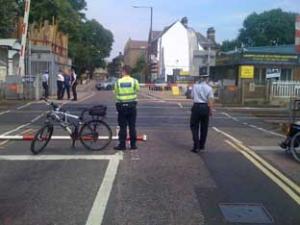
The scene at the level crossing last weekWednesday: train delayed because of incident at the White Hart Lane level crossing. Just like the one reported here:
Sheen Lane crossing most misused in Britain (From Richmond and Twickenham Times)

While I'm on about the level crossing, we may eventually get a level crossing in North Sheen -I've been campaigning for years and lobbying MP Susan Kramer. Not before 2010 it seems though....

In the meantime, schoolchildren will probably continue to jump it.

Still on about level crossings, our MP's met with Network rail, but with little results it seems.

See my previous posts on the level crossings.


, , , , , , , , , , , , ,

Friday, February 27, 2009

Heathrow is just dangerous where it is

Last year, the BA038 flight narrowly avoided catastrophe when the Boeing 777 crash-landed just short of Heathrow's perimeter fence after nearly shaving houses, gliding only 6 meters above cars on the A30.

Yesterday, the Turkish Airlines 1951 crashed 3km north of Schipol's runway.

There are striking resemblances between both accidents: in both cases, the Engines stalled and as the BA038 AIBB report implies, it's quite a miracle in both caes that there was no fire after impact, despite the landing gear perforating the fuel tanks and the fire switch not being activated in the proper squence for the British Airways flight.

Where there are differences though, is in the configuration of the airports: Schipol has been built away from Amsterdam, to allow for approaches over the North Sea and minimise nuisances. In passing, Netherlands, and especially Noord Holland, is the densest European country.

This muddy field explains largely why most of the Turkish Airlines 1951 passengers escaped unharmed despite the fuselage breaking in three sections on impact. Note that Turkish has a good safety reputation and that the Boeing 737-800

If a two engine aircraft (I keep thinking four engines are better...) lost power in the same way while on final approach to Heathrow it would end up right on Cardington square, Hounslow. In the best case, it would be a small aricraft falling on a single nearly empty house like the Continental 3407.

Heathrow flight paths are directly above 2 millions people, a 747 crash on Richmond high street would be way more ugly...


See also: Heathrow is not safe: chilling crash map

Tuesday, January 20, 2009

Essential reading: 2M Group on Heathrow Expansion

Stop Heathrow Expansion
The 2M Group
has an excellent summary on the economics of Heathrow. No need to add much:


Current airport


• Fewer than 26% of users of Heathrow are travelling on Business(1).


35% of people travelling to Heathrow are interchange passengers – they
never leave the airport. Therefore they contribute little to the UK
economy outside of the aviation industry.


• 100,000 flights
a year, nearly a fifth of all flights, are to destinations in the UK or
near-Europe where there is already a viable rail alternative. There are
60 flights per day to Paris – more than any other destination. 36
flights a day go to Manchester, more than to Hong Kong or Chicago.


London’s airports handle 128 million passengers a year – that is more
than use the airports serving Paris and Frankfurt combined.


Ferrovial, the Spanish owners of Heathrow, make a substantial profit
from passengers using the airport. In the year since Ferrovial bought BAA (the operators of Heathrow) – capital investment fell by 15% but revenue grew from £1.077 billion to £1.232 billion.


Heathrow Expansion


• Only 1% of members of the Institute of Directors think airport expansion is a priority(2).


• 78% of London firms are against expansion at Heathrow(3).


• Fewer than a sixth of London firms would even consider leaving London if the airport did not expand(4).


Aviation generally


• £9 billion a year in tax subsidies is given to the aviation industry (It is zero-rated for VAT. It does not pay on fuel).


• Aviation fuel costs 26p a litre whereas petrol for cars is about £1 a litre.


£9 billion would pay for 22 new hospitals(5) – it cost £400 million to
build London’s University College Hospital – or 450,000 nurses (current
nursing positions advertised at £20,000(6).


• 89% of the general public think that businesses that create pollution should be more heavily taxed(7).


• 63% of the general public would be prepared to sacrifice one foreign holiday a year to save the planet(8).


• Only 17% of the general public are opposed to constraining growth in air-travel(9).


Tourists visiting the UK spend at least £15 billion pounds less per
year than UK tourists going on holiday overseas. Expanding aviation
simply means increasing the trade deficit for UK tourism.


, , , , , ,

Thursday, January 15, 2009

Hoon's farce as Heathrow expansion is announced

Geoff Hoon gave in the lobbies arguments and gave the Government's Go-ahead for new Heathrow runway.

His arguments are farcical for a lack of better words to describe their implausibility and the inadequacy of measures aimed at alleviating the impact of a third runway:
  • The languge about the "the possibility of new high-speed rail links from the airport" means it's unlikely to happen. Same goes for the idea of "set[tting] up a company to look into creating a high speed rail line between London and Scotland - adding there was a "strong case" for a new high speed rail hub at Heathrow": it's just there to appease opponents.
  • The 125,000 flights cap probably won't meet EU emissions regulations (thanks god to the European Union for making rules to protect citizens from their own government), even with his fictional "green planes"
  • More passengers means more car traffic. The government's answer is to use hard shoulders. Brilliant, except anyone who's travelled on the M4 at peak hours knows that any little incident already causes a major congestion.
The only good news for Richmond residents was the concession to keep the "mixed mode" use of runways (plane noise only half of the day), however nothing on night fligts. But those living further West will be exposes to more takeoff noise thanks to the end of the Cranford agreement.

BAA and the DfT conveniently forget to state that there are FOUR other airports around London when making the case to expand Heathrow. An estuary airport would have been cheaper that T5 + T6 + a 4rd runway.

Finally, the economic case for LHR is based on un-proven assumptions.

Most major European countries have in the last 20 years:
  • relocated their main airport
  • invested in high-speed rail
  • created multimodal nodes (air+rail)

During this time, British ones sat on their bottoms... (read also What if those who govern us had a long term view about strategic infrastructures?)

Here's the Decision text in full.


, , , , , , , , , , , , ,

Thursday, January 08, 2009

What if those who govern us had a long term view about strategic infrastructures?

I posted the following comments on this blog post of this morning:
The Toleration Of Public Transport on Jonathan MacDonald.com

These are the consequences of the refusal to invest in a proper public transportation system for 30 years: high prices and bad service.

They've tried to privatise and introduce competition, but the idea just doesn't work with infrastructure: you just can't make a profit, provide universal access, good interconnections and good service with redundant infrastructure.

If the government had taken a long term approach, the results could be:
- that the Eurostar platforms don't stand un-used for a year after they've innaugurated High Speed 1 and St Pancras International, when on the other hand trains are waiting for a platform on approach to Waterloo station
- that the Waterloo and City line would not be an isolated branch but would serve as a junction tunnel between the overground in Waterloo to the overground in Moorgate (strange that no one ever thought that trains could come from Reading / Portsmouth all the way to Stevenage / Cambridge)
- an airport in the estuary with 5 runways instead of 5 airports in dense conurbations, each with 1 or 2 runways
- a high-speed line to the Midlands and Scotland, with an interchange with the Eurostar
- Water pipes that are buried so that they don't freeze when the temperature drops

And so on... it's a long story of incompetence and short-sighted decisions.


, , , , , , , , ,

Monday, January 05, 2009

Monday, November 17, 2008

Airtrack and North Sheen Crossing

I picked up last week a flyer from the LibDems at North Sheen station, to read that at my great pleasure Susan Kramer has obtained that the footbridge to the South side of the track will be rebuilt.

This is not only a practical issue, as with the new train schedules the level crossing in Manor road is down a a lot (read in the RTT: Level crossing bottlenecks choking Richmond, apparently it could be 75% of the time in the future!) it is also a safety issue. Indeed, I'm glad to get someone chiming in on something I've raised over two years ago:

Assembly member Caroline Pidgeon discussed safety concerns to pedestrians brought about by the delays.She said: “People get so frustrated waiting for the barriers thatsome have been tempted to go round them and run across the tracks.“Children have been seen doing this and it’s just an accident waiting to happen.”

It's also unfair for local residents: we get all the congestion but only four trains per hour at peak time. At least, we should get four trains per hour off-peak as well.

(plus, let's fine stationary cars too: Stuck at a level crossing? Turn off the engine or pay £20 fine - The Times)

What's the link with this and Airtrack, the plan to improve Heathrow's access by rail? At first sight, it looks like a good idea, and I am always supportive for better public transport.

However, it's hard to read without being suspicious of BAA's intentions, here's my take:

  1. BAA and BA build a new terminal in Heathrow (despite massive local opposition, read on BBC.com: Heathrow runway debate a 'sham'), claiming it's vital for the economy (without supporting this with any proof) and despite London being served by 4 other airports...
  2. Oh, shoot, access to Heathrow by public transport isn't that good and, as opposed to what's going on the continent, there's no high-speed rail link.
  3. And, bugger, if they extend the airport, they won't meet the new EU emission criteria, even with BAA's imaginary green’ jumbo (The Times).
  4. Easy: they just improve the public transport and create a car-free zone around the airport.
  5. Expensive? Not really, they say let's just extend the existing train lines, charge more for parking and create a road tax on the model of Red Ken's London Congestion Charge.
The snag? The train network, for not having received significant investments in the last 30 years, is completely saturated in the South East of England. And those trains to Heathrow, they will have to run somewhere. Like through Richmond...

This is why I oppose Airtrack, unless they actually invest significantly to increase rail capacity: North Sheen should be buried underground, a car park created on top to encourage people to park and take the train and we should see 8 trains an hour.

You can make your views heard on Thursday


Read my other posts on the North Sheen footbridge and those on Heathrow Expansion.

And also: MPs attack Airtrack (RTT)


Tags: , , , , , , , , , , , , , , ,

Thursday, October 23, 2008

BAA wakes up to the sound of locomotives?

Train- © hfng - Fotolia.com. Plane- © Lars Christensen - Fotolia.comBAA changed their whining pitch and now says that Heathrow 'needs rail links as well as third runway' (Evening Standard).

That's of course after the Tories said they were in favour of a £20bn plan for a 180mph rail link instead of Heathrow third runway.

At a conference BAA urged the rail industry to work with the aviationsector to generate a "once-in-a- generation opportunity to create aworld-leading air and transport hub at Heathrow". BAA said its aim isfor a "third runway built within strict environmental limits and ahigh-speed rail network that will connect the UK's hub airport withevery major centre of population across the country".

Yeah right. Seems like they want to have their cake and eat it. Personally, I frankly doubt they really want high-speed rail: in France, the SNCF predicts that the introduction of high-speed trains running at 360 kph (224 mph) would mean that the airlines passenger share between Paris and Toulouse (585 km or 360 miles) would fall from 80% to 30%.

But they kept some of their usual lies: "Mr Condie highlighted Paris and Frankfurt, which have both developed high-speed rail links and have more runways than Heathrow."
This of course is misleading as they compare Heathrow (2 runways) instead of London (5 runways, plus one un-used in Gatwick) to other capitals. What is true is that both France and Germany have linked high-speed trains (TGV and ICE) to airports.

Read also my other posts on Heathrow expansion.

, , , , , , , ,

Friday, October 10, 2008

Stanstead and City granted expansion: what does it mean for Heathrow?

In the news yesterday:
Stansted and City airports get the expansion go ahead | Greenpeace UK

So, where does that leave us?

It looks like the government (and the councils) are not serious about the green agenda but are rather happy to listen to the aviation lobbies.

Heathrow expansion (the current plan is a third runway between the A4 and M4, requiring to bulldoze 700 homes, effectively razing Sipson) is probably the most controversial: because it's the busiest airport but also the worst location (Westerly winds prevalence means its flight paths send planes droning over no less than 2 MILLIONS of residents.
The most enraging is that both the Government (the Dft) and BAA have been consistently lying and breaking promises over the years.

I think the solution is to do what worked elsewhere: instead of talking about Heathrow not being competitive compared to
other European capitals, conveniently forgeting that only London has
FIVE international airports, the DfT should plan (do they know the meaning of the word though?) ahead and do what many other capitals done by relocating their airport.
Of course, they should also invest in rail: read Lyon-Paris vs. Manchester-London (from Euroblog by Jon Worth)


Read also:


, , , , , , , , ,

Friday, July 29, 2005

I dreamt about doing this!!!!

Hats off to Hacan for doing something I wanted to see for a long time:

BA boss gets early morning plane blasts (Richmond & Twickenham Times, 22/07/05)
THE boss of British Airways was woken up by blasting aircraft noise at 5am at his quiet Berkshire village home this week. The protesters rigged up a sound system outside the chief executives home and blasted out aircraft noise for 15 minutes. "The majority of night flights using Heathrow are operated by British Airways or one of its subsidiary companies. And BA is amongst the strongest supporters of night flights." As you have guessed, we live under the flight path, just like another MILLION of people in London (one of the few cities in London where flight paths go OVER down-town). This means we can get 747's cargos at 3 am or 4am, and then early morning traffic from 6 am. We have experienced it: it really affects kids sleeping patterns....